Home :: Tree Planting :: Tree Pruning :: Tree Fertilizing :: Trees & Climate ::  About Us :: Contact Us ::

Tree & Landscape Articles :: Site Map :: Disclaimer :: Privacy


Tree Fertilizing


Newly planted trees

If you used a good soil mix when planting your new trees, you probably don't need to fertilize at this time.
However, if you planted with existing soil from the site, fertilizing could be a beneficial  recovery from
the planting shock.  NEVER, place fertilizer in the planting hole during the planting of any
plant.
 Either, broadcast fertilizer on top of the planting area or wait for one growing season. 

Another concern has to do with infertile soil found around new home construction. The soil removed during
the digging of the basement could have been spread during the filling and grading operation.  This soil has bad
physical soil properties and almost a complete lack of nutrients for good plant growth. In this case, a Fertilizer application is a must.
 

Use a good slow release fertilizer like OsmocoteŽ Classic.  This fertilizer has been the top-of- line since 1960.  It will provide feeding for a good 3 - 4 months of Longevity at 70°F.  Real late fall or early spring time
for making the application.  Other fertilizers can be used, such as 10-10-10 or 14-14-14. 


Existing trees

If the leaves on the tree are of normal size and color, the tree is probably feeding just find.

Trees that are not growing and trees that have had a back insect or disease problem should be fertilized
to help them to grow out their current situation and put them back on a healthy path. Trees growing
in compacted soils and were tree roots are growing in a restricted area near a sidewalk, driveway or a building foundation.

A clear sign of the need for fertilization is small leaves, off color foliage, ends of the branches have dead twigs and showing little or no growth.  Some nutrient deficiencies show up as discoloration in the leaves.  this condition has the name Chlorosis.  This condition appears as a light yellow-green color mainly between the veins on the leaf. It usually associated with the lack of Iron, but other necessary nutrients, such as nitrogen, phosphorus and potassium have certain defining characteristic.


Never use a combination fertilizer that has a weed killer included.  several years ago, I had a client that had a privacy planting around her yard of large shrubs.  She called me because her shrubs were all showing signs
of wilting. She asked me what was causing this problem and I said it is weed killer damage.  She thought it was air pollution and I told here to check the plants in her neighbors yards.  No sign of any injury next doors.
She told me that there no way that it could be  a weed killer problem.  No weed killer had been applied.
Oh yes, here gardener had placed fertilizer around all of the plants and it had 2,4-D in the fertilizer combination.

Most commercial fertilizers consist of inorganic materials blended together to provide one or more essential nutrients. Trees require large amounts of Nitrogen, Phosphorus and Potassium along with trace elements.
Fertilizers are commonly expressed in three numbers like 5-10-5 or 10-10-10.  The first number 5 is the percentage of Nitrogen, the second number10 is percent of Phosphorus (P205) Phosphate and the third number 5 is the percentage of Potassium (K20) or Potash.

Application Methods

Surface Application is quick and less effort.  Apply to the surface under the tree while the is not
damp.  Again, late fall or real early spring is the best time of the year.  Use 5 lbs. of actual nitrogen/1000 sq.ft. of 10-10-10- or 14-14-14 by making 3 applications  at 1 1/2 lbs per 1000 sq.ft. at about 3 to 4 weeks apart. Water in the fertilizer after each application so a build of the fertilizer will not occur.

Flowering Trees should not be fertilized unless necessary because it will keep the tree in a growth cycle
which means much fewer flowers.

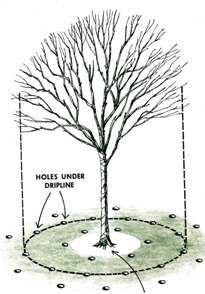
In Soil Application as per the enclosed picture. Make 1 1/2" holes in a circle around the trunk
starting 3 ft. out from the trunk and additional circles about 2 ft. apart.  the distance between holes should be at 2 ft. intervals out until at least 3 ft out from drip line of branches above.

                                                                                                                                                        3 ft. From The Trunk

Lawrence Hoyle, Senior Landscape Designer
lhoyle@amazing-crabapple-trees.com
Amazing-Crabapple-Trees.com
4032 May Breeze Rd. 
Marietta, Georgia, 30066-2734
Phone:(770) 924-0304 
Fax:(770)924-0593


Lawrence and oldest granddaughter                                            

Plan Before You Plant!!           

 A great Online Landscape Design Service. I have 46 years of
Landscape Design Experience.  Take advantage of My knowledge
get the best design for your Yard.

www.web-landscape-design-ideas.com

Submit Photos and Property Measurements for your
Landscape Plan


copyright2007@www.amazing-crabapple-trees.com